ModoPersona for Heads of Customer Success
Know which clients need a plan for their next QBR
Before the Customer Success meeting, you need to know which clients need a plan for their next quarterly business review (QBR). QBRs recorded in Notion can help prepare questions for Customer Success Managers (CSMs). A missing record alone does not mean the meeting did not happen.
Private workspace for one manager. No employee accounts required.
Illustrative product example
Fictional Customer Success meeting example
Three situations before the QBR review
Fictional QBR history · Review on 26 September 2026
- Darwin · QBRs on 1 January, 1 April, and 30 June suggest a 90-day rhythm and a next date around 28 September. Who will confirm the plan with the client?
- Northstar · The estimated window has passed. Did the QBR happen without a record, move by agreement, or does the CSM need your help?
- Arc · Only one QBR is recorded. That is not enough to estimate a regular cadence; agree the next date with the CSM.
The job to be done
QBR history does not yet confirm the next plan
One client has a regular meeting rhythm, another moved the date, and a third has only one recorded QBR. Separate the estimated next date from a confirmed plan, and find where the team needs a decision or help from you.
How ModoPersona handles it
A focused workflow, with the source still visible
Check the table your team already uses
If Notion is available in Settings, share the relevant data source. ModoPersona reads its structure first. Before importing metadata, verify that it is the right table of completed QBRs. You can also work through the process manually in your existing tracker.
Confirm which records represent completed QBRs
Map the title, client relation, meeting date, QBR tag, and optional CSM or creator. Only matching metadata is cached. Free-form client notes and QBR page bodies stay in Notion.
Prepare a question about each client's next plan
ModoPersona groups QBRs by client and estimates the next date from the observed intervals. Check dates and uncertainty. Ask the CSM whether the meeting is agreed, moved, or simply unrecorded. Then confirm the next step, owner, and due date.
See the workspace
Context stays useful because you can inspect it
The walkthrough uses synthetic data to show preparation, person-specific context, evidence, and manager commitments in one workspace.
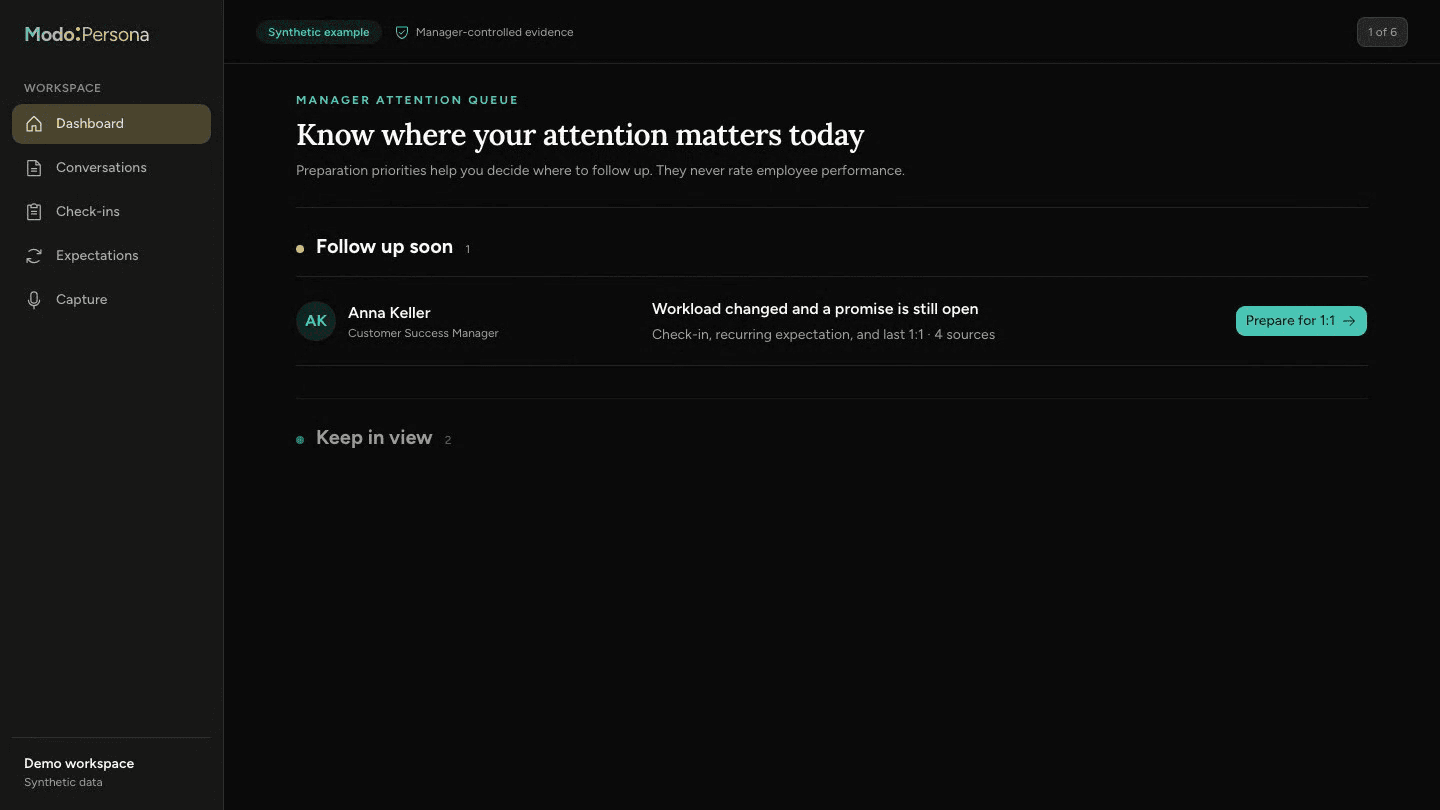
An estimated date helps clarify the plan
Every next QBR date is labelled as inferred from history. A missing record is a question for the CSM, not proof of a missed commitment. ModoPersona does not read QBR page bodies, evaluate account quality, rank CSMs, or make renewal decisions.
Questions managers ask
- Can ModoPersona confirm that a CSM completed every QBR?
- It shows source-linked records that match the confirmed fields and clients whose history suggests attention. An absent record does not prove the QBR did not happen. Check the actual situation with the CSM.
- Does the team need to record QBRs in another system?
- No. The leader connects the existing source with read-only access and confirms its structure. CSMs can keep recording completed QBRs in Notion. Check connection availability in Settings.
Continue exploring ModoPersona
- IntegrationsConnect Notion without turning pages into employee evidenceConnect Notion through a schema-first workflow, then explicitly map selected metadata for supported manager preparation use cases.
- Use casesTrack the promises you make as a managerKeep manager-owned promises visible with the person, source, and due date so they return before trust depends on remembering them.
- Built forPrepare engineering 1:1s with Jira context and past conversationsPrepare engineering 1:1s with Jira, calendar timing, past conversations, and your own commitments. Follow a worked example from blocker to next conversation.
- Prepare for a 1:1: 10-Minute Guide | ModoPersonaPrepare for your next 1:1 in ten minutes: revisit past promises, choose two questions and decide where to help. Includes a fictional two-meeting example.
Prepare for one better conversation
Start with one direct report, bring in the context you trust, and see what returns before the next one-on-one.
Start a 14-day trial