Management meeting preparation
Prepare for the management meeting without narrating every Jira ticket
A useful management meeting should focus on the few things that need shared attention, not reproduce the task tracker line by line. ModoPersona prepares a private draft for the manager from confirmed context and connected work history, then separates what deserves discussion from activity that colleagues can already inspect in Jira, Linear, Asana, or Notion.
Private workspace for one manager. No employee accounts required.
Illustrative product example
Example management brief
Monday leadership meeting · Product and engineering
Two-week period · Private manager workspace · Source-linked draft
- Win · The onboarding milestone moved to done; recognize the cross-team outcome.
- Discuss · The security review date changed after an external dependency slipped.
- Decision needed · Confirm whether management can provide a reviewer this week.
- Already visible · Routine Jira tickets remain available in Jira and do not need narration.
- Missing information · The latest Notion synchronization failed; verify the current plan.
The job to be done
Task activity is visible, but the managerial meaning is still scattered
A completed milestone may deserve recognition, a changed due date may reveal a dependency, and a synchronization failure may mean the apparent picture is incomplete. Managers usually reconstruct those distinctions from memory just before the meeting. Reading every employee's tickets aloud adds surveillance without answering what changed, where support is needed, or which decision cannot wait.
How ModoPersona handles it
A focused workflow, with the source still visible
Prepare on the rhythm your team actually uses
Generate a brief when needed or schedule a private draft every one to eight weeks, including weekly and biweekly cadences. Choose a custom period when the meeting does not follow the usual schedule, and continue from the last completed period when it does.
Distinguish discussion from already-visible work
The draft groups wins, blockers, dependencies, commitment changes, decisions, support requests, missing information, and connected activity. Routine task status remains explicitly marked as already visible so the meeting can concentrate on managerial judgment rather than employee-by-employee narration.
Review every claim before taking it into the room
Each generated item retains its source. The manager can edit wording, change its section, omit it, restore it, or add private context before finalizing the brief. If connected evidence is unavailable or incomplete, the gap is shown rather than silently filled with an inference.
See the workspace
Context stays useful because you can inspect it
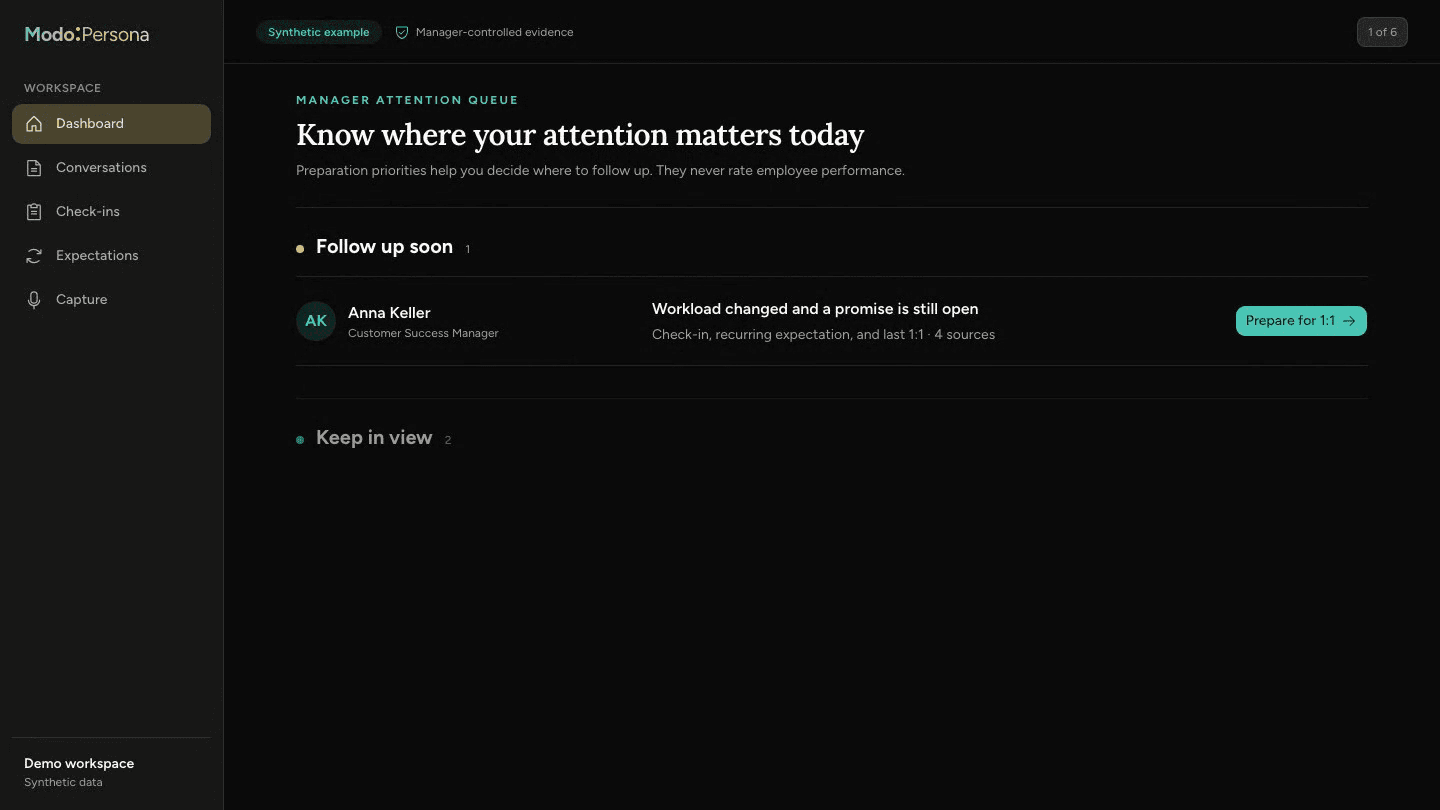
The walkthrough uses synthetic data to show preparation, person-specific context, evidence, and manager commitments in one workspace.
A managerial layer, not an employee activity report
ModoPersona does not explain what every employee did, score individual activity, infer effort from ticket movement, or write conclusions back to connected systems. The brief stays inside one manager's private workspace. It helps that manager recognize outcomes, expose dependencies, verify missing context, and ask for decisions; it is not a cross-organization sharing or monitoring system.
Questions managers ask
- Does the brief replace Jira or another task tracker?
- No. Jira and similar tools remain the source for task-level activity. The brief links back to that evidence and adds the managerial distinction between an item worth discussing and work that is already visible there.
- Can the brief be prepared biweekly instead of weekly?
- Yes. A manager can generate a custom-period brief or schedule recurring private drafts from every one to eight weeks. Weekly and biweekly are ordinary choices, not hardcoded assumptions about the company's meeting rhythm.
Continue exploring ModoPersona
- IntegrationsBring Jira context into your next one-on-oneConnect Jira to ModoPersona for read-only, person-linked work context before one-on-one meetings, without employee scoring or write-back.
- IntegrationsConnect Notion without turning pages into employee evidenceConnect Notion through a schema-first workflow, then explicitly map selected metadata for supported manager preparation use cases.
- Use casesTrack the promises you make as a managerKeep manager-owned promises visible with the person, source, and due date so they return before trust depends on remembering them.
Prepare for one better conversation
Start with one direct report, bring in the context you trust, and see what returns before the next one-on-one.
Start a 14-day trial