Follow-through between one-on-ones
Remember the follow-up after the meeting ends
Trust erodes when a manager repeatedly asks for updates but forgets what they promised in return. ModoPersona separates manager-owned and employee-owned commitments and returns unresolved items before the next conversation.
Private workspace for one manager. No employee accounts required.
Illustrative product example
Example follow-up set
After the platform 1:1
Manager-reviewed draft
- Manager · Share the promotion rubric · Due Friday
- Employee · Draft the migration decision · No stated due date
- Manager · Introduce Priya to the security lead · Open
The job to be done
Action items fail when ownership becomes fuzzy
A recap may contain five possible next steps, but only some are genuine commitments. Without a clear owner and source, a reminder can quietly become an unfair expectation or a promise can disappear altogether.
How ModoPersona handles it
A focused workflow, with the source still visible
Confirm the proposed follow-up
After a recap, review drafted follow-up language before anything is treated as agreed. Keep the exact source available and correct the owner or wording when needed.
Separate your promises from theirs
Manager-owned commitments receive the same visibility as employee-owned actions. That keeps preparation from becoming a one-sided accountability list.
Revisit unresolved work in context
Open commitments appear with the relevant person and meeting context. A due date is shown only when it was recorded; ModoPersona does not invent urgency.
See the workspace
Context stays useful because you can inspect it
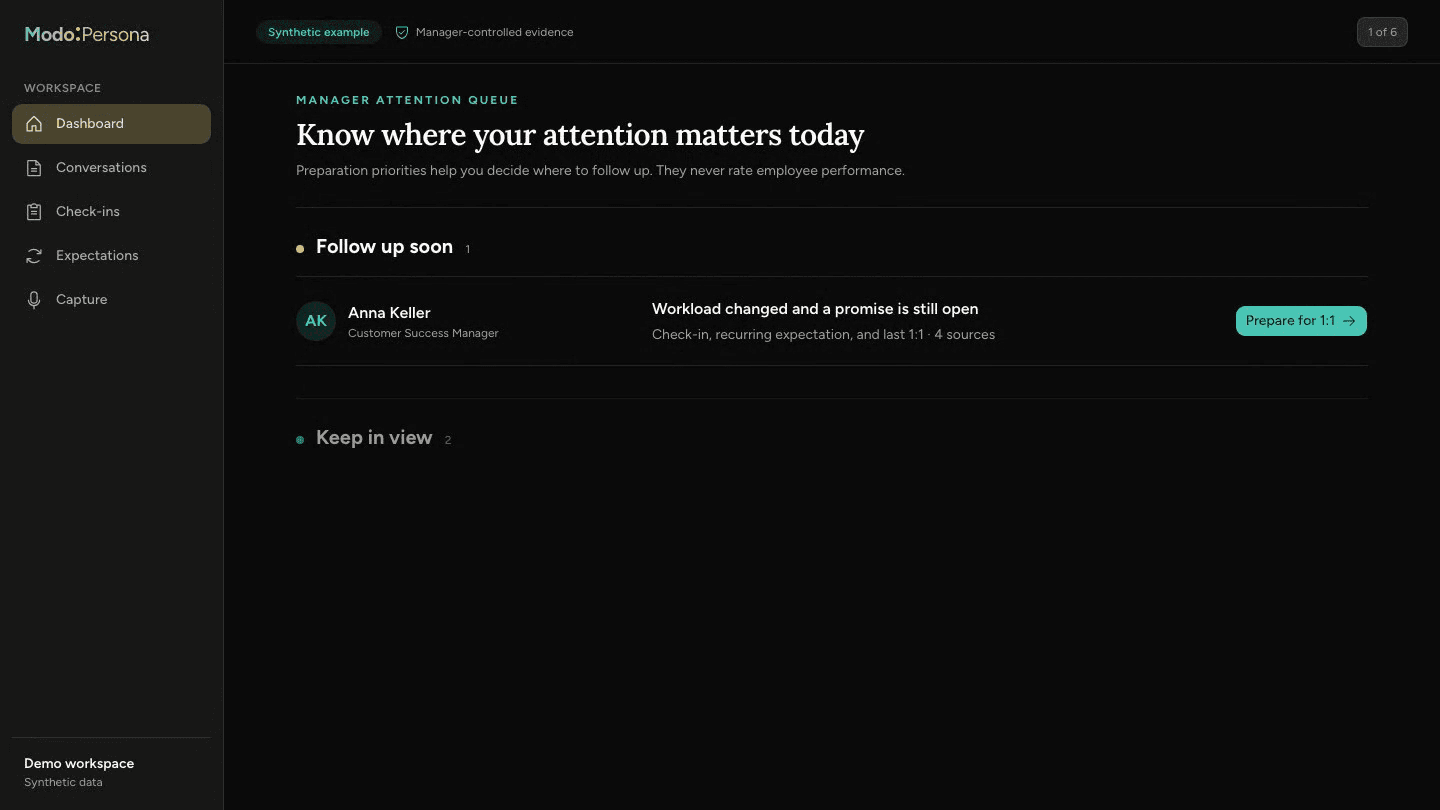
The walkthrough uses synthetic data to show preparation, person-specific context, evidence, and manager commitments in one workspace.
A follow-up is not surveillance
ModoPersona does not infer task completion from activity or silently grade reliability. Work context can help frame a question; the manager confirms what was agreed and what changed.
Questions managers ask
- Does ModoPersona automatically assign tasks to employees?
- No. Proposed follow-ups require manager review, and connected work systems are used as read-only preparation context.
- Can I add a due date later?
- Follow-up context can preserve a known due date. If no deadline was agreed, the preparation view should say so rather than invent one.
Continue exploring ModoPersona
- Use casesTrack the promises you make as a managerKeep manager-owned promises visible with the person, source, and due date so they return before trust depends on remembering them.
- Use casesBring a useful question to your next one-on-onePrepare one-on-ones from past agreements, recent notes, and your own promises. A worked example and a ten-minute preparation guide.
- IntegrationsBring Asana context into your next one-on-oneConnect Asana to ModoPersona for read-only, person-linked work context before one-on-one meetings, without employee scoring or write-back.
Prepare for one better conversation
Start with one direct report, bring in the context you trust, and see what returns before the next one-on-one.
Start a 14-day trial